International Network of Inductive Theologies
If (systematic) theology is understood as reflection on faith and on questions of meaning and values in the light of the theological tradition, then theology has a relationship with current beliefs, lifeworlds and orientations. This relations is reflected and explored within the International Network of Inductive Theologies (InIT).

Quelle: susan-q-yin-BiWM-utpVVc-unsplash
If (systematic) theology is understood as reflection on faith and on questions of meaning and values in the light of the theological tradition, then theology has a relationship with current beliefs, lifeworlds and orientations. As simple as it sounds as difficult is it to determine how this relationship is concretely defined in contemporary systematic theology.
Internationally and in other disciplines of theology, the search for connections between the lifeworld and theological reflection has led to a variety of approaches: In approaches of “lived theology”, “ordinary theology”, “lived religion”, “public theology”, “narrative ethics”, “liberation theology”, “constructive theology” or even “pragmatist theology”, the focus is shifting to the contemporary lifeworld as the starting point and subject of theology – often opposed to “dogmatic theology” or “Systematic Theology” understood as a only theoretical endeavour concerned with dogma and tradition.
These relations are reflected and explored within the International Network of Inductive Theologies (InIT). After exploring the field in an international working group initiated by PD Dr. Frederike van Oorschot (FEST) and Dr. Lea Chilian (Zürich) from 2023-2025, the International Network of Inductive Theologies (InIT) (since 2025) wants to specify the task, approach and contribution of inductive theologies in interdisciplinary discourse, the interplay of theological disciplines and within the broader empirical turn within the humanities and cultural sciences.
Members of the Board:
- PD Dr. Frederike van Oorschot (FEST Heidelberg)
- Dr. Lea Chilian (Zürich)
- Prof. Dr. Kristin Graff-Kallevag (Oslo)
- Prof. Dr. Matthew R. Robinson (Lüneburg)
- Prof. Dr. Henco van der Westhuizen (Bloemfontein)
- Dr. Natalie Wigg-Stevenson (Toronto)
- Prof. Dr. Raúl Zegarra-Medina (Harvard)
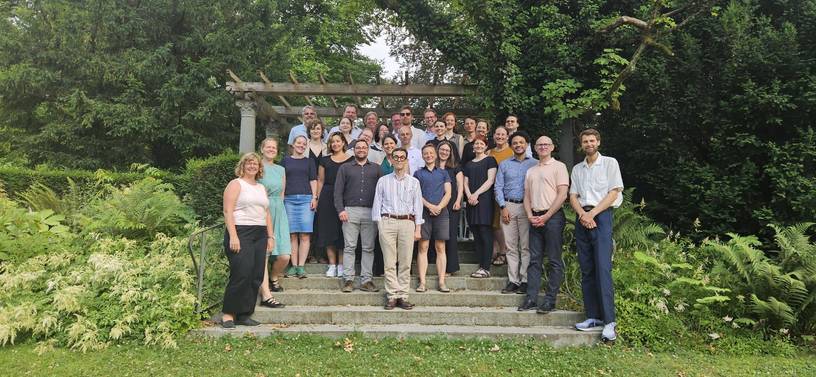
Founding of the International Network for Inductive Theologies (June 2025)
Quelle: Frederike van Oorschot
Members of International Network of Inductive Theologies (InIT):

Quelle: Frederike van Oorschot
If you are interested in being part of the International Network of Inductive Theologies, please contact PD Dr. Frederike van Oorschot (FEST) or Dr. Lea Chilian (Zürich).
Publications
Topical Issue: “Inductive Theology. How Systematic Theologies Can Relate to Everyday Life”, Open Theology 10.1 (2024). https://doi.org/10.1515/opth-2024-0021
Chilian, Lea; van Oorschot, Frederike: Induktive Theologie? Oder: Wie sich Theologie auf die Gegenwart beziehen kan. Feinschwarz. 31.05.2023. https://www.feinschwarz.net/induktive-theologie/
Workshops of the Working Group "Inductive Theologies":
Induction, Deduction and Abduction as Heuristic Perspectives of ST - Heidelberg, June 3-4 2024
- What are the perspectives of thinking and research in doing STs?
- What reference points do STs have and what is their function?
- Where do we find and how do we describe the objects of STs?
- How do STs relate to “the present” (repository for possible topics and questions, task for hermeneutical interpretation [research] object, "reality check" for tradition/scripture, etc.)?
- To what extent and how is past the subject of STs?
- With: Hanna Reichel (Princeton), Natalie Wigg-Stevenson (Toronto), Jan-Olav Henriksen (Oslo), Sarah Jäger (Jena) and Elisabeth Maikranz (Heidelberg)
Criteria for the relation to „present life“ in STs - Online, November, 14-15 2024
- (How) Is normativity a task of ST?
- Is “systematization” a specific feature of STs relating to other theological disciplines?
- How can lived theologies and other empirical research approaches be assessed in ST? Or can/is lived theology be a criterion for dogmatic judgments? („Lebensdienlichkeit“)
- Which methodologies of perception can we relate to, e.g. from empirical research (Narrative Ethics, Empiricism), or from hermeneutical theology?
- Relation between empiricism and other approaches to the world (empiricism as verification of individual perception of the world, critique of empiricism as task of ST)
Inductive Theology between the theological disciplines - Zürich, July, 03-04 2025
- How do the entanglements of empirical, hermeneutical, and normative issues are related in the theological disciplines?
- Are there opportunities for constructive ways of “division of labor” between ST and PT?
- How are the historical disciplines involved in these questions?
- What competencies do systematic theologians need?
Quelle: Frederike van Oorschot
The working group was supported by Wissenschaftliche Gesellschaft für Theologie/Fachgruppe Systematische Theologie.